


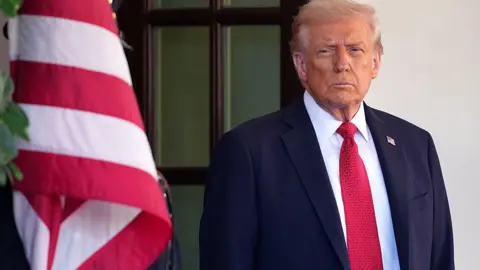
The US is not planning to perform atomic detonations, Secretary Wright has announced, alleviating worldwide apprehension after Donald Trump instructed the defense establishment to restart weapon experiments.
"These cannot be classified as nuclear explosions," Wright told a television network on the weekend. "These are what we term explosions without critical mass."
The comments follow days after Trump posted on Truth Social that he had directed military leaders to "start testing our nuclear arms on an equal basis" with competing nations.
But Wright, whose organization oversees experimentation, clarified that people living in the Nevada test site should have "no worries" about seeing a mushroom cloud.
"Americans near former testing grounds such as the Nevada security facility have no cause for concern," Wright said. "This involves testing all the remaining elements of a nuclear device to ensure they deliver the correct configuration, and they prepare the nuclear detonation."
International Feedback and Refutations
Trump's remarks on his platform last week were perceived by several as a signal the United States was getting ready to restart complete nuclear detonations for the first occasion since 1992.
In an interview with a television show on a broadcast network, which was recorded on the end of the week and shown on the weekend, Trump restated his stance.
"I'm saying that we're going to perform atomic experiments like different nations do, indeed," Trump said when questioned by CBS's Norah O'Donnell if he planned for the US to set off a nuclear device for the first instance in several decades.
"Russian experiments, and China's testing, but they do not disclose it," he added.
Russia and Beijing have not conducted these experiments since the early 1990s and the mid-1990s in turn.
Pressed further on the subject, Trump said: "They don't go and disclose it."
"I prefer not to be the exclusive state that avoids testing," he stated, mentioning Pyongyang and the Islamic Republic to the list of countries allegedly evaluating their arsenals.
On the start of the week, Chinese officials refuted performing atomic experiments.
As a "responsible nuclear-weapons state, Beijing has consistently... maintained a self-defence nuclear strategy and abided by its promise to suspend nuclear examinations," official spokesperson Mao announced at a routine media briefing in the city.
She noted that China desired the America would "adopt tangible steps to secure the worldwide denuclearization and non-dissemination framework and uphold global strategic balance and security."
On Thursday, the Russian government also disputed it had performed nuclear examinations.
"Concerning the experiments of Poseidon and Burevestnik, we hope that the data was conveyed correctly to the President," Moscow's representative told journalists, mentioning the titles of Moscow's arms. "This cannot in any way be interpreted as a nuclear examination."
Nuclear Arsenals and International Data
The DPRK is the sole nation that has performed nuclear examinations since the the last decade of the 20th century - and including the regime announced a halt in 2018.
The exact number of nuclear devices maintained by every nation is confidential in all situations - but Russia is thought to have a aggregate of about 5,459 devices while the America has about five thousand one hundred seventy-seven, according to the an expert group.
Another Stateside institute provides moderately increased projections, saying the US's atomic inventory stands at about 5,225 devices, while Russia has about 5,580.
China is the global number three nuclear nation with about 600 devices, the French Republic has 290, the United Kingdom two hundred twenty-five, New Delhi one hundred eighty, the Islamic Republic 170, Israel 90 and the DPRK 50, according to studies.
According to another US think tank, China has nearly multiplied its nuclear arsenal in the last five years and is expected to exceed 1,000 arms by the next decade.


